
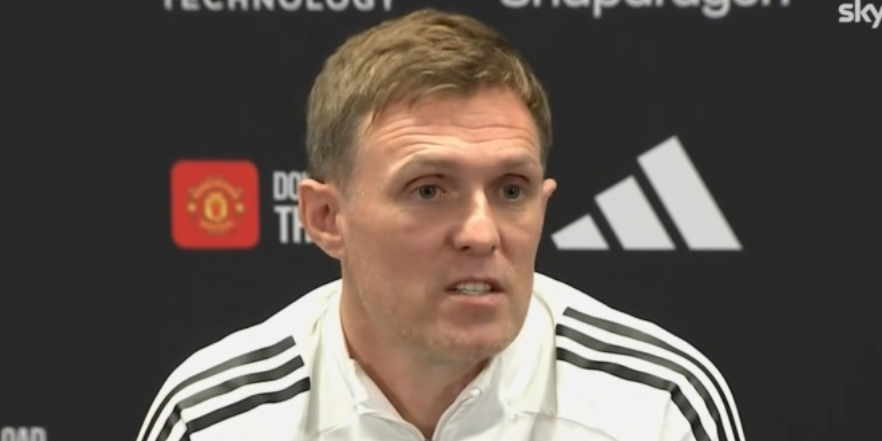
Ahead of Manchester United’s clash with Burnley, caretaker manager Darren Fletcher attended the pre-match press conference to field journalists’ questions.
You mentioned feeling uneasy about taking over the team under such circumstances, which is completely understandable. Did you speak to Rúben before he left yesterday?
“I didn’t get the chance. I reached out to him, but we couldn’t connect, which is understandable. He obviously had a lot on his mind, and I was also extremely busy, so it just didn’t happen. I would have loved to talk to him because Ruben and I have a really good relationship. He was very kind to me. At the end of last season, when I was working as the U18 coach, he and his team made me feel very welcome. We’ve also had some interactions this year since I’ve been working on the other side of the training ground. So we’ve always had a good rapport. And ultimately, he’s the manager who gave my son his debut, so as a father, I have a lot to thank him for—for Tyler’s opportunity. Although the kids earn their chances through their own efforts, it’s the manager who makes the final call. So Ruben and I are on good terms. Of course, I feel disappointed for him, but what’s done is done. I’m here to help the club, and we have to move forward quickly. As I said before, everything I do is in the best interests of the club, which is why I’m fully focused on Burnley right now.”
An unavoidable question—since taking on this role, have you spoken to Sir Alex (Ferguson)?
“I have. I don’t like making any decisions or doing anything without consulting Sir Alex, and that’s been the case ever since I joined the club and even after I left. Sir Alex and I have an extremely close relationship, so he was probably the first person I called. I wanted to talk to him first. Honestly, at the end of the day, I wanted to get his blessing. I think he deserves that respect. I wanted to hear his thoughts, and he was supportive, echoing the views I’ve always held. Your job is to do what’s best for Manchester United. When you’re an employee of this club, your duty is to give your all for United. It was fantastic to hear him say those words, words that I strive to live by and believe in every day. So having his backing meant a lot to me.”
You were a great player here, achieving so much success. You’ve been back at the club for four or five years now, holding various roles. From your experience, how much of an impact do you think external scrutiny—from people like us, comments from former players, the entire media landscape—has on the players in the dressing room? Do you think it matters?
“I think it does have an impact because it’s part and parcel of being a Manchester United player, but I can only reflect on my own experience as a player. This kind of scrutiny existed when I was playing. When I first broke into the team as a young player, we finished as runners-up in a season, and it felt like the end of the world. I’ve been through that. Looking back, I feel incredibly fortunate that we had Sir Alex, we had Roy Keane, and we had all those experienced players around us who protected and helped us. Fundamentally, things are different now because there will never be another Sir Alex Ferguson. So it’s tough, but that’s the case at every club, and this is the biggest club in the world. So that level of scrutiny, expectation, and standards comes with the territory—you have to deal with it. You have to learn how to handle it, you have to seek help to cope with it, but it also comes naturally over time. Some players need more time to adapt, but gradually, they have to try and deal with it consistently. That’s the life of a footballer; that’s the modern world, and it’s something players have to learn to navigate. And they will. Sometimes it takes time, sometimes some can’t manage it, but that’s life, that’s reality. My view is that it’s there, and you have to learn to handle it. Find what works best for you and embrace the challenge of being at Manchester United.”
On that note, Darren, Ruben mentioned several times here and on Sunday that comments from Gary Neville could influence decision-making. How difficult is it for the club to bounce back when this kind of noise is happening every day? Do you need stronger leaders in the dressing room, or do you need some former players to understand the situation and tone down their criticism?
“You can’t ask them to tone it down because they’re passionate, they have their own opinions, and they’re brilliant, articulate voices that deserve to be heard. I love listening to them—I sat in the dressing room listening to them for years, soaking everything up. It’s difficult, but you have to block it out. The most important thing is winning football matches, winning trophies, and going on a journey. That’s life, that’s football—especially here. The bottom line is results. People want to see United win, they want to be entertained. There’s a standard of what Manchester United is and what people expect. Honestly, I think the fans at Old Trafford have been absolutely fantastic in recent years. There have been occasional moments, but overall, the support they’ve given the players and the manager—their understanding of the situation—could have easily led to a much more toxic atmosphere inside the stadium. I’ve experienced more tense and hostile environments at other grounds, so perhaps the players have to deal more with the external noise than the actual pressure inside the stadium. That should help, and I think the fans have been exceptional in that regard. Sitting here today, I want to ask them to get behind the players—not me. Support the players and the club because they need that backing, they need that help. The external noise, the comments from former players—it’s hard to deal with, it’s not easy, because those players have won everything. They have success and trophies to their names, so it’s difficult to argue against their criticism when they have the medals to back it up. It’s really, really tough, but again, it’s part and parcel of being a Manchester United player. You have to accept it, learn how you’re going to handle it, and embrace the challenge.”
What’s the training atmosphere been like over the past few days? Also, have you chosen to have one-on-one conversations with the players? I know you mentioned Bruno and Mount, but is there a possibility of Kobbie Mainoo returning?
“Kobbie (Mainoo) actually took part in some training today, but he’ll need to be assessed tomorrow. That’s part of the plan—he’ll undergo an evaluation tomorrow. I’ve had conversations with the players; it’s been time-consuming. I actually planned to have more talks, but maybe the first day as Manchester United manager is busier than you might expect. I originally intended to speak to a lot of the players, but that didn’t quite happen. I spoke to Bruno, which was important because he’s the captain, and I wanted to have that chat with him. In fact, I focused on speaking to some players I don’t know as well—players like Matheus Cunha and Benjamin Šeško. I actually spoke to Senne Lammens not long ago, but these two were my priority because I didn’t have much of a relationship with them. I wanted to get to know them, and I wanted them to get to know me. As for the other players, I know them well. I’ve worked with them in the past, so those two and Bruno were the main ones I spoke to. With tomorrow’s match approaching, there will be some more individual conversations and meetings, as well as chats around the canteen and training ground. I think that’s really important.”
Is this more about communicating your expectations to them, or are you actually keen to hear what they have to say?
“A bit of both, to be honest. Getting to know them, having a dialogue, asking them questions about how they’re feeling here, what their experience of the club has been like, and how they see things—just trying to understand my perception of them as players, how they’ve been doing recently, things like that. It’s really just having a chat, getting to know them, taking the first step towards building a relationship instead of being distant. When you know 95% of the squad but not these two, I think it’s important to make that effort.”
How would you assess the players’ mentality and confidence? Obviously, the past 48 hours have been quite turbulent for them.
“I think confidence-wise, everyone is at a different stage—it’s such a crucial part of football. You have players coming back from injuries, players who have missed games, and they all have their own mindsets. Some players are in good form, some are struggling, so confidence fluctuates. I think you can sense that no one likes to see someone lose their job. You could feel that around the training ground yesterday, but today you have to move forward very, very quickly. The important thing is that we go into the game with positive energy. We can’t go into the match against Burnley without that good energy. You have to move on quickly—that’s vital. Football is a ruthless game; that’s life, that’s football. So the key is that we try to generate a bit of energy, a bit of spirit, which I think we did today, and hopefully we can build on that tomorrow.”